
Cellar Conversions in Huddersfield: Maximizing Space in Textile Trade Properties
Quick answer
What does a cellar conversion in Huddersfield involve?
Huddersfield cellar conversions range from GBP 20,000 to GBP 55,000 depending on the cellar's condition and water ingress. Many Huddersfield properties have sound Victorian cellars with good bones, but waterproofing is usually required due to the town's geology and historical water management.
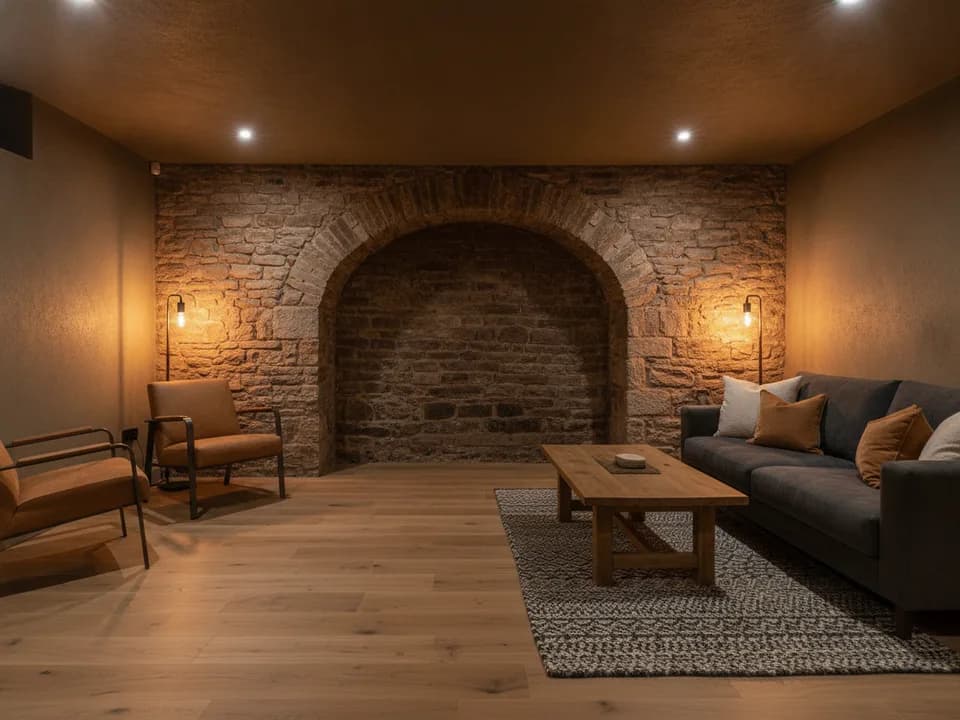
Huddersfield's Victorian prosperity, built on the wool and worsted trade, left behind substantial townhouses and terraces, many with excellent cellars. Properties across town and inner-city neighbourhoods often feature brick cellars with generous proportions, originally designed for storage, textile work, or servants' quarters. RM Lee Cellar Conversions has transformed Huddersfield cellars into bedrooms, studios, home offices, and playrooms, helping owners unlock valuable living space. Huddersfield sits in the Colne Valley with variable water conditions depending on slope and proximity to the Colne or Holme rivers, so our survey approach is location-specific. The town's hillside topography means some properties have excellent natural drainage (making waterproofing simpler), while properties on valley floors need more robust systems. Huddersfield's property market has seen steady recovery, and converting a cellar into a bedroom or office can add genuine value, particularly in inner-city streets where space is scarce. Our free survey includes moisture testing, groundwater assessment, structural inspection, and evaluation of any existing damp-proofing. We then specify a waterproofing solution tailored to your cellar's specific conditions, whether that's straightforward tanking or full cavity drainage with sump and pump.
Also available
Other services we offer in Huddersfield
Basement Waterproofing
A genuinely dry cellar starts here, cavity drainage and sump systems specified to suit Yorkshire's older housing stock.
Cellar Tanking
A cementitious tanking slurry coat, specified honestly, for cellars where it is the right fit rather than the easy sell.
Timber Treatment
Damp cellars attack timber quietly for years. We treat or replace affected joists once the underlying damp is fixed.
Questions
Huddersfield Cellar Conversions FAQs
Topography and proximity to water are key. Properties near the Colne or Holme, or in lower-lying streets, experience higher water tables and occasional flooding risk. Hilltop properties usually have better drainage. Our survey identifies your cellar's risk level so we specify appropriate waterproofing.
Yes, if you're creating a new habitable room. Storage or utility spaces may not need permission. We advise at survey whether your scheme likely needs consent.
Victorian Huddersfield properties typically have 15-35 sqm cellars depending on the building's original size. Larger townhouses may have 40+ sqm. Size affects project scope and cost. Our survey measures exactly.
Our survey includes structural engineer assessment for cracks, movement, degradation, and load-bearing capacity. If the cellar is sound (most Victorian brickwork is), we proceed with design. If there are issues, we specify structural remediation.
Tanking (membrane-based) costs roughly GBP 40-80 per sqm. Cavity drainage (with sump and pump) costs GBP 80-150 per sqm. For a 25 sqm cellar, that's GBP 1k-2k vs GBP 2k-3.75k. Which is right depends on water table and expected water pressure. Our survey advises.
Yes, and they're well-suited to it: typically cooler than upstairs, good for cardio work, and soundproofing can minimize noise to neighbours. Proper ventilation and drainage prevent sweat-related moisture issues.
Waterproofing alone is 2-4 weeks. Full conversion with M&E and finishing runs 10-16 weeks depending on scope. We schedule around your occupation to minimize disruption.
Waterproofing alone is GBP 50-100 per sqm. Full conversion runs GBP 300-500 per sqm. A 25 sqm cellar might cost GBP 1.25k-2.5k for waterproofing or GBP 7.5k-12.5k for complete fit-out.
Many converted mills and mill-adjacent properties do have cellars, though some are underused. We assess commercial and residential conversions. Commercial cellar conversion may have different requirements (fire egress, commercial standards), so we check applicability early.
Modern extractor fans (humidistat-controlled) are standard. Passive vents can be added if the cellar is near an outside wall. For larger cellars or residential bedrooms, MVHR (mechanical ventilation with heat recovery) is sometimes worth considering. Our MEP team designs the right solution.
Yes. Winter and spring see higher groundwater; summer is typically drier. This is normal and doesn't affect a properly waterproofed cellar. However, if tanking is marginal, seasonal changes might show leaks. Our cavity drainage systems handle seasonal fluctuations reliably.
Structural adequacy, waterproofing, headroom (2.1m minimum for habitable, 2.4m preferred), ventilation, heating, electrical safety, emergency egress (for bedrooms). We design to meet all standards.